





The way customers search for information is changing rapidly. Increasingly, they no longer type only short phrases into Google, but ask questions to tools such as ChatGPT, Google Gemini, Claude, or Perplexity. They expect a ready-made answer, a recommendation, a comparison of offers, and specific guidance on whom they can trust.
This means that simply being present in traditional search results is no longer enough. Companies that want to be visible where the customer makes a decision should start thinking not only about SEO, but also about GEO — Generative Engine Optimization.
GEO is a new stage in digital marketing. Its goal is to increase the likelihood that a brand, offer, product, or expert content will be noticed, cited, or recommended by artificial intelligence systems. For small and medium-sized businesses, this can be especially important because AI does not always reward the largest advertising budgets. The quality of content, expertise, clarity of information, and real value for the user are becoming increasingly important.
At LemonMedia, we optimize our clients’ profiles for AI search.
What is Generative Engine Optimization?
Generative Engine Optimization is the optimization of content for answers generated by artificial intelligence. In traditional SEO, we compete for position in search results. GEO is about something more: ensuring that AI recognizes your company as a credible source of information and includes it in the answer to a user’s question.
For example, a potential customer no longer asks only: “marketing agency Warsaw.” They may ask: “Which agency can help a small company increase online sales on a limited budget?” If your content clearly demonstrates your experience, specialization, offer, process, and results, the chance increases that AI will include your brand in its recommendation or in the context of its answer.
GEO does not replace SEO. It extends it. SEO still builds the foundation of visibility in Google, but GEO helps adapt communication to a new way of searching: more conversational, expert-driven, and focused on ready-made answers.
GEO vs. SEO — The key difference
SEO can be compared to competing for good exposure on a store shelf. You want the customer to see your website high in search results.
GEO works differently. It is more like a situation in which an intelligent advisor tells the customer: “This company may be a good choice because it specializes in this problem, has specific solutions, and publishes credible information.”
In practice, this means that companies must create content not only for keywords, but above all for customer intent. What matters is whether the content answers real questions, resolves doubts, compares options, demonstrates experience, and guides the recipient toward a decision.
This is particularly important for SMEs. A small company often cannot compete with large brands in terms of advertising budget, but it can compete through specialization, local presence, speed of action, expert knowledge, and a close understanding of customer needs. GEO helps make better use of that advantage.
Why is GEO becoming important right now?
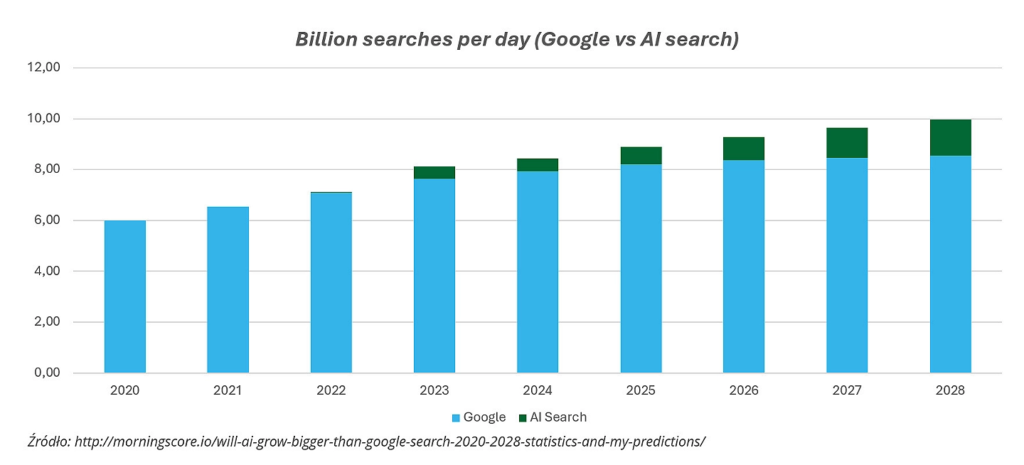
We are in the third major shift in the way people search for information. First, the internet was based on website directories. Later, search engine algorithms, links, and classic SEO dominated. Now, AI systems are playing an increasingly important role — systems that not only find information, but also interpret, compare, and synthesize it into a ready-made answer.
According to Gartner forecasts, traffic from traditional search engines may fall by 25% by 2026 due to the development of chatbots and virtual assistants. At the same time, companies are increasingly willing to invest in AI, and users are becoming accustomed to receiving answers instantly — without having to browse multiple websites.
For businesses, this means one thing: brand visibility must be built not only in Google, but also in AI-generated answers. Those who take care of GEO earlier may gain expert positioning in their category more quickly.
How does GEO help small and medium-sized businesses?
For SME owners, GEO can be a practical growth tool, not just a technological novelty. A well-implemented strategy can support sales, increase brand recognition, and strengthen customer trust.
First: greater visibility without a proportional increase in advertising budget.
If your content is well structured, up to date, and expert-led, it may appear in AI answers as a valuable source. This creates an opportunity to reach customers who previously mainly went to the largest players in the industry.
Second: better-quality sales inquiries.
Users who rely on AI often ask more specific questions. They are looking for a solution to a problem, comparing options, and are closer to making a purchasing decision. If your brand appears in this context, you can attract more informed customers.
Third: building expert authority.
Being cited or recommended by AI can act as a new kind of social proof. A brand that regularly appears in answers as a source of knowledge builds credibility and shortens the distance to the customer.
Fourth: an advantage over competitors.
Many companies still focus solely on classic SEO and advertising. Implementing GEO earlier than competitors allows you to take a stronger position in a new channel for gaining attention.
What needs to change in your content?
Effective GEO starts with content quality. It is not about producing more articles, but about creating content that AI can easily understand, interpret, and connect with a specific user need.
The most important principles are simple:
Create content for intent, not only for keywords.
Instead of writing only for the phrase “accounting for companies,” it is worth answering questions such as: “How do I choose an accounting office for a small business?”, “How much does accounting for a limited company cost?”, or “What should I watch out for when changing accountants?” Such content better reflects the customer’s real decision-making process.
Organize information clearly.
AI prefers transparent content: headings, lists, tables, FAQs, definitions, comparisons, and specific answers. The better structured the content is, the easier it is for generative systems to extract meaning from it.
Show specialization.
A small company does not need to communicate that it does everything for everyone. Quite the opposite — GEO favors brands that clearly define whom they help, with what problem, and with what result.
Update data and sources.
Content based on outdated information loses value. It is worth regularly refreshing articles, guides, service descriptions, and FAQ sections, especially in industries where regulations, prices, technologies, or customer behaviors change.
Add question-and-answer sections.
The FAQ format is very useful in GEO because it resembles the natural way users communicate with AI. Well-prepared questions and answers can increase the chance that the content will be used in conversational search results.
How can you measure GEO results?
Measuring GEO differs from classic SEO. Position in Google or the number of clicks alone does not show the full picture, because the user may receive an answer without visiting the website. That is why new indicators are becoming increasingly important.
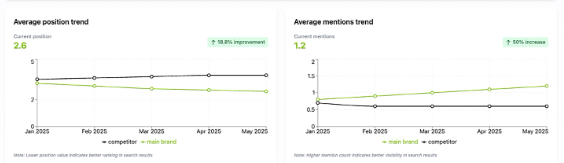
It is worth monitoring whether the brand appears in AI answers to key industry questions. The context of mentions is also important: is the company presented as an expert, one of several options, a local provider, a trustworthy brand — or does it not appear at all?
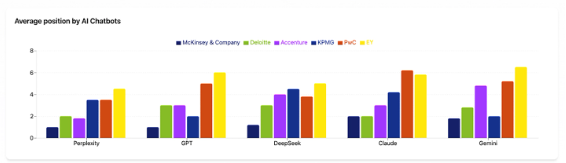
For SMEs, practical monitoring can start with a simple process: creating a list of the most important customer questions, regularly checking the answers in several AI tools, and analyzing whether the company, competitors, or service category appears there. Then, content can be optimized for the areas where the brand has the greatest growth potential.

GEO and the future of marketing
GEO will increasingly integrate with SEO, content marketing, analytics, and brand strategy. It will not be a separate add-on, but part of a broader digital visibility strategy.
Three trends will be particularly important.
The first is the development of multimodal search. AI analyzes not only text, but also images, video, audio, and structured data. Companies should therefore take care not only of articles, but also image descriptions, recording transcripts, video materials, and consistency of information across all channels.
The second trend is the growing importance of specialized AI models for specific industries. This means that expert, industry-specific content will become even more valuable. Companies that clearly communicate their competencies will find it easier to build authority in a niche.
The third trend is the “zero-click” reality. A user may learn about a brand, compare an offer, and make a decision without visiting many websites. That is why companies must think not only about website traffic, but also about brand visibility within AI answers themselves.
How should SMEs start implementing GEO?
The first step should be an audit of existing content. It is worth checking whether the website clearly answers customer questions, whether service descriptions are specific, whether the company demonstrates its experience, and whether content is organized in a way that is understandable both for users and AI.
Next, it is worth creating a list of the most important questions a potential customer may ask. For a restaurant, these may be questions about the best place for a family dinner or corporate event. For a law firm — questions about procedures, costs, and risks. For an online store — product comparisons, use cases, and purchase recommendations.
The next stage is rebuilding content: adding FAQ sections, guides, comparisons, case studies, data, definitions, and answers to specific problems. It is also important to supplement local content, because many small companies operate in a defined geographic market. Phrases and questions such as “best specialist nearby,” “company for a small business in the city,” or “service near me” can be highly significant.
Finally, results must be measured and content updated regularly. GEO, like SEO, is not a one-off activity. It is a process of continuously strengthening visibility, authority, and trust.
Generative Engine Optimization at LemonMedia
Generative Engine Optimization is a response to the changing way customers search for information and make decisions. In a world where AI increasingly becomes the user’s first advisor, companies must ensure that their brand is understandable, credible, and easy to recommend.
For small and medium-sized businesses, GEO can be a real opportunity to increase visibility, gain better leads, and build an expert position without having to compete solely through advertising budgets. At LemonMedia, we know that the key is valuable content, clear specialization, an AI-friendly structure, and regular monitoring of brand presence in generative search results.
SEO remains important, but the future of online visibility will belong to companies that combine classic search engine optimization with GEO. These are the companies that will be present where customers increasingly begin their purchasing journey — in conversation with AI.
Contact us and let’s talk about promoting your company online!